


.svg)

contact@blackcoffeerobotics.com

India, USA
2025 was a year of working in two modes at once. We were still building demos and exploring new ideas, but a much larger share of our time went into production readiness compared to previous years. Real hardware, real constraints, and systems that needed to run repeatedly and predictably shaped most of our work.
Across projects, demo quality and production quality were not separate phases, they had to evolve together. That tension defined the year.
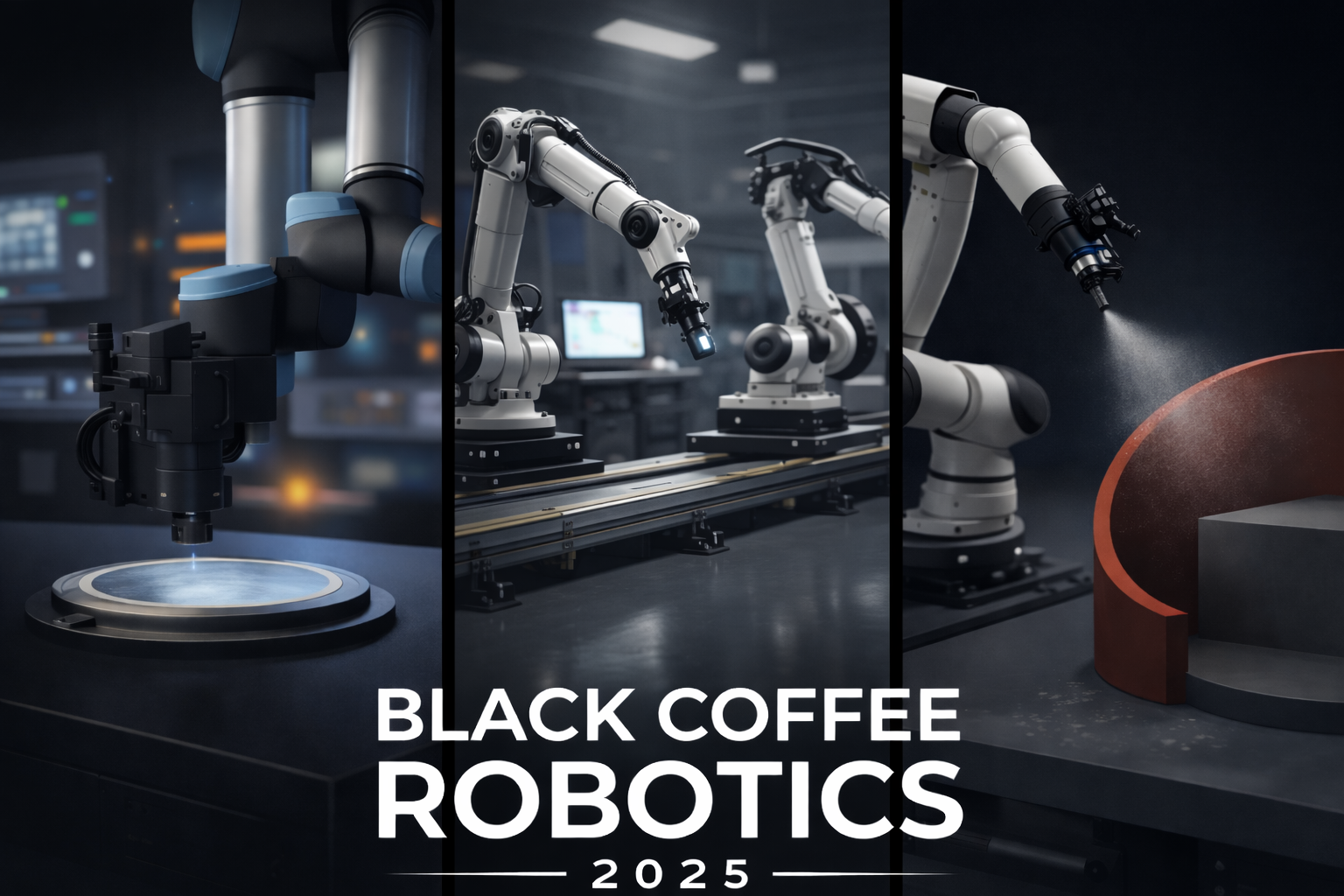
A major part of the year was spent on an industrial robotic arms system for wall panel construction, using a dual-arm, rail-mounted setup. The work covered end-to-end system integration: industrial arms with limited ROS2 support, rail motion, perception-driven manipulation, and human-in-the-loop teleoperation for debugging, recovery, and iteration.
We deployed a motion planning stack, integrated perception tightly with motion execution, and pushed the system toward production-ready throughput. This was not a clean progression from demo to production. Both had to exist simultaneously, under schedule pressure. The team was stretched, but pulled through.
This project significantly deepened our experience with layout optimization, safety engineering, hardware integration, and millisecond-level motion planning, especially when vision and human feedback are part of the execution loop.
We started working with PickNik this year around real-world usage of MoveIt Pro as a motion planning platform. The work has been focused on understanding how motion planning systems behave in actual industrial applications, beyond controlled demos or research setups.
This has given us strong exposure to deployment practices, application constraints, and the kinds of edge cases that determine whether a planning stack is usable in production. The collaboration has been a solid learning channel, and we are optimistic about building further in this direction.
Another stream of work focused on productionizing mapping pipelines on budget-friendly hardware. The emphasis was on performance, particularly for floor mapping under tight compute and sensor constraints.
This reinforced a recurring pattern we see across projects: under real limits, careful systems engineering and profiling matter far more than algorithmic novelty.
We also worked on lab automation systems using robotic arms, collaborating with a globally distributed hardware team. The focus has been on reliability, integration, and turning individual capabilities into a usable end-to-end workflow. This effort is expected to come together in early 2026.
Motion planning has been central across almost everything we worked on. We are comfortable saying this is an area of deep expertise for us. In 2025, that expertise was pushed into harder territory: constrained planning, performance under tight timing budgets, interaction with perception noise, and predictable behavior in application contexts.
We have already solved several practical issues that commonly block deployment, particularly around constraint handling and making planning behavior stable and understandable. There are still hard problems left, but motion planning is one of the areas where we feel strongest going forward.
Simulation remains necessary and frustrating. We spent time working with high-fidelity simulation, including deformable bodies and particle-based approaches. These are useful for select use cases, but remain heavy, brittle, and expensive to maintain.
Across projects, the lesson was consistent: simulation creates value only when tightly coupled to planning, control, and real-world validation. On its own, it rarely does.
There has been a lot of buzz around Vision-Language-Action and other foundation-model approaches. We explored this space as well. The demos are compelling, and the momentum is real, but practical deployment remains difficult.
Data collection, infrastructure, task-specific fine-tuning, evaluation, and reliability guarantees are still hard problems. The gap between impressive demos and dependable applications is real. This is an area we are watching closely, but not one we are betting production systems on yet.
Open source continues to be one of the most rewarding parts of what we do, because usage is an honest signal.
Seeing people use what we build, without us pushing it, remains one of the clearest indicators of value.
AI-assisted coding has been genuinely helpful for us, but only when used correctly. It does not replace understanding. A black-box approach does not work.
When you broadly know what you are doing and can guide the system, the speedups are real. Used blindly, it produces brittle software and the illusion of progress. It is leverage, not a shortcut.
Going into 2026, our focus is clear: accelerating real-world robot deployments.
We are doubling down on robotic arms, reliable motion planning, and application readiness. The goal is not novelty or hype, but systems that survive deployment and behave predictably under real constraints.

.webp)
contact@blackcoffeerobotics.com
India, USA